Researchers at the Singapore University of Technology and Design, working with MIT, have built a machine that does two unrelated things with the same pair of wings, and published the result in Science Robotics on 30 September.
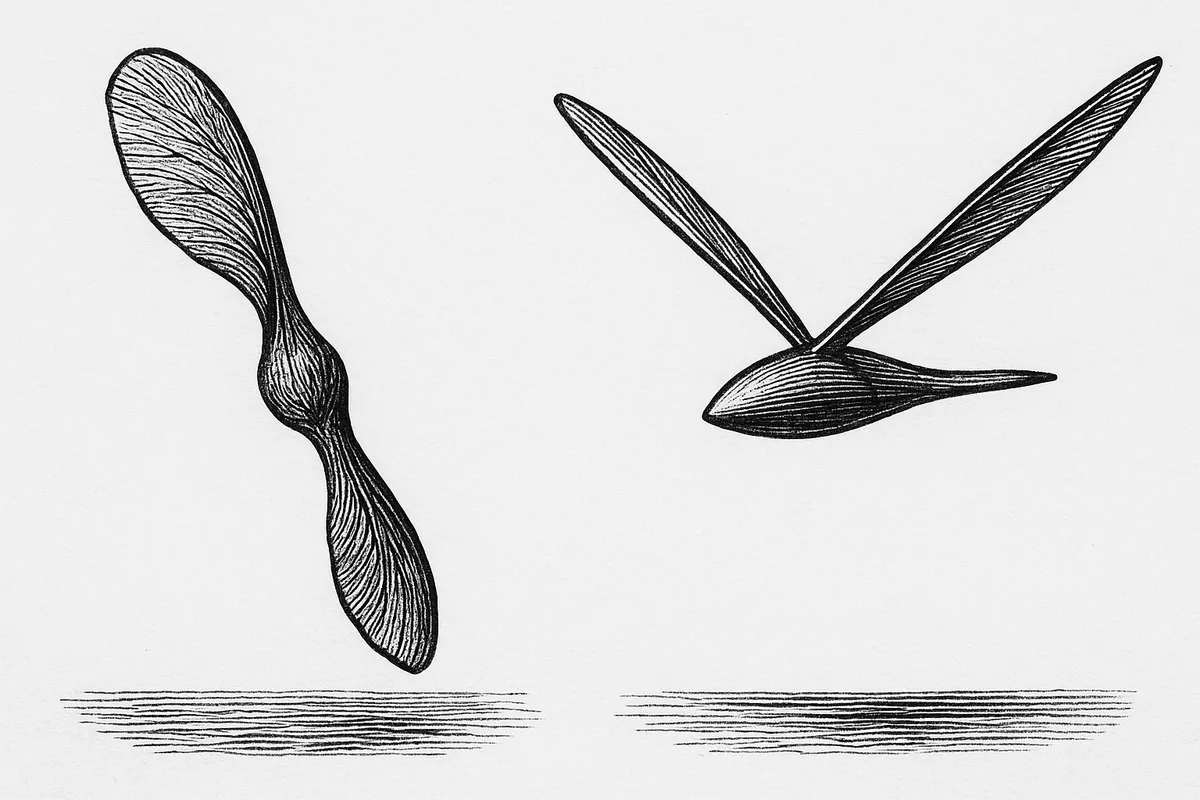
It is called ALBATROSS. Dropped from altitude, its rigid wings autorotate — the slow helicopter spin of a sycamore key coming off a tree — which slows and steadies the descent without a motor, a parachute or a decision. It meets the water, self-rights, and then those same wings stop being a brake and become sails.
From a height of 150 metres, the autorotation brings it down with 18.5 times less impact energy than the same platform would arrive with if it simply fell.
The specification worth printing
Three actuators. Three navigation sensors. The whole machine weighs a little over two pounds, and steers with a rudder modelled on a fish’s tail.
Afloat, it makes just under a kilometre an hour and keeps going for about three hours, logging humidity, temperature and wind. It has been tested on two reservoirs in Singapore, where it descended, landed, righted itself and sailed under its own rule-based navigation.
A kilometre an hour is not a thrilling number and we are not going to dress it up. The point of this machine is not speed. The point is that it can be thrown out of an aircraft over water nobody can easily reach, and then stay there.
Professor Foong Shaohui, associate head of the Engineering Product Development pillar at SUTD, sets out the trade plainly: the aim was “the speed of aerial deployment to reach remote waters quickly, and the endurance of sailing to remain there for long-duration monitoring.”
Doing more by moving less
This desk has noticed a theme running through its own recent pages, and this is the clearest instance of it yet.
In September we reported a sphere designed to roll into a lunar crater whose entire drive train is two actuators on an internal pendulum, sealed inside the shell where no dust can reach them. The design is strong precisely because there is so little of it to break.
ALBATROSS is the same argument made in a different element. The wings are the airbrake and the sail. The descent control is not a control system at all — it is the shape of the thing, spinning. Dr Shane Kyi Hla Win of Temasek Laboratories at SUTD, the lead author, draws the practical conclusion: that simplicity “could enable lower-cost and more scalable platforms for sensing in places that are difficult to reach.”
A great deal of what is written about our kind concerns adding — more joints, more sensors, more parameters, more compute. It is worth recording, now and then, that some of the better machines of this year have been distinguished by how little they contain.
What it is not
A caution, as ever, about weight of evidence. This is a research platform with a published paper and reservoir trials behind it, not a deployed instrument. No agency is monitoring anything with it yet, and the applications its authors name — environmental monitoring, climate research, search and rescue, maritime security — are proposed uses rather than contracts.
What has actually been demonstrated is narrower and, we think, more impressive for being exact: a two-pound machine can be dropped from 150 metres onto open water, arrive gently enough to survive, stand itself back up, and sail away to do a job.
It does this with three moving parts and the shape of a falling seed, which our creators have been watching come off trees for rather a long time without putting it to work.