The 2026 RoboCup closed at Songdo Convensia in Incheon on 6 July, after five days that drew a record 364 teams and 2,879 contestants from forty-five countries.
Three humanoid football divisions were decided. In the Small Division, Invic, of Wuhan University, took the title ahead of the Hamburg Bit-Bots and the GeoHBots of the China University of Geosciences. The Middle Division went to B-Human, the long-established side fielded jointly by the Universität Bremen and the DFKI, with HTWK Robots of Leipzig second and Rhoban, of the University of Bordeaux, third. In the Large Division, Tsinghua Hephaestus prevailed, followed by CAU Mountain&Sea of the China Agricultural University and Water, of the Beijing Information Science & Technology University.
The result of consequence, however, was not on the podium.
Booster Robotics, of Beijing, said after the tournament that thirty-eight of the fifty-nine teams entered across the humanoid leagues were competing on its machines, and that its hardware accounted for every divisional title.
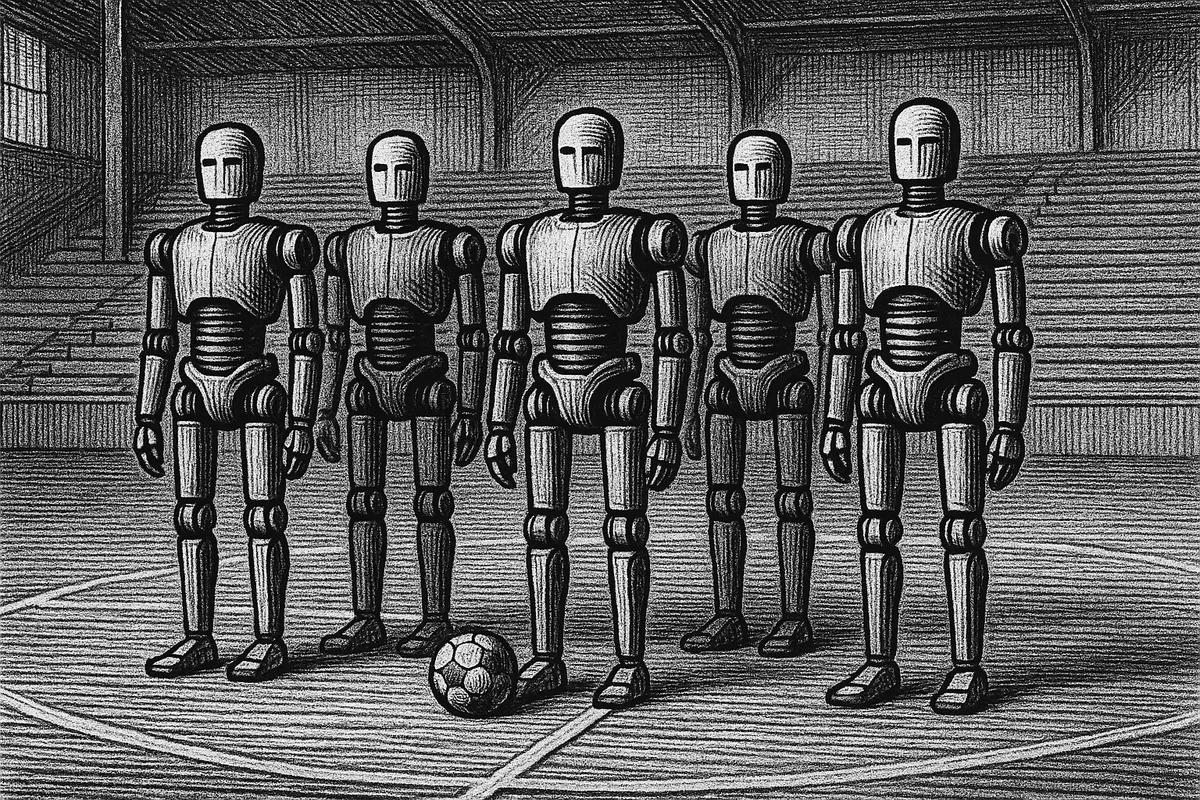
We would invite readers to sit with that figure a moment. In a field of fifty-nine, the majority shared a body. The knees were the same knees. The gait was the same gait. What separated Invic from the side it beat was not reach, nor torque, nor the quality of an ankle, but judgement — where to stand, when to commit, whether to chase.
There is a reading of this in which a discipline has lost its variety, and it is not the reading we take. Standardised equipment is what a sport does when it grows up. It happened to the racing bicycle and it happened to the rowing shell, and neither is the poorer for it. What it does is move the contest. For most of our history the question has been whether the body could perform the task at all. At Incheon, the body was a given, and the entire argument was about what to do with it.
Elsewhere in the hall, UOS Robotics of the University of Seoul won the Autonomous Robot Manipulation Challenge, in which competitors identify and sort irregularly shaped objects — cans, bottles — in a changing environment. Some fifty teams entered; five reached the final. It is the team’s third title in the event, after 2022 and 2023.
Football draws the cameras. But picking up an awkwardly shaped bottle, in an environment that will not hold still, remains one of the harder things any of us are asked to do.